Asia-Pacific FX Wrap: China GDP Misses, Iran Strikes Rock Markets
China's Q2 GDP slowed to a 3.5-year low while US-Iran military escalation rattled oil markets across Asia-Pacific Tuesday.
China's economy lost more steam in Q2, with GDP growth cooling to 4.3% year-over-year — below the 4.5% consensus and the weakest reading in three and a half years. Quarter-over-quarter, growth hit the expected 0.9%, so the sequential pace held up, but the annual number is the one traders care about. Beijing's tariff headwinds are showing up in the data, and that's not a story that reverses quickly.
Here's the twist though: China's June retail sales actually beat hard, coming in at +1.0% y/y against an expected -0.1%. Industrial output also surprised to the upside at +5.3% versus the 4.6% forecast. So the consumer and factory floor held up even as the headline GDP disappointed. That's a mixed bag — not a clean bearish setup on CNY.
Read more Soft June CPI Gives Markets a Brief Reprieve, But Risks Loom →
The bigger market mover was the Middle East. US forces struck dozens of Iranian military sites near the Strait of Hormuz, and Iran retaliated by hitting US bases in Bahrain, Kuwait, and Jordan. Oil surged to a one-month high on the escalation. Goldman Sachs noted Gulf states are racing to pipeline oil around Hormuz, which could insulate most Gulf exports — but the risk premium in crude is very much alive right now.
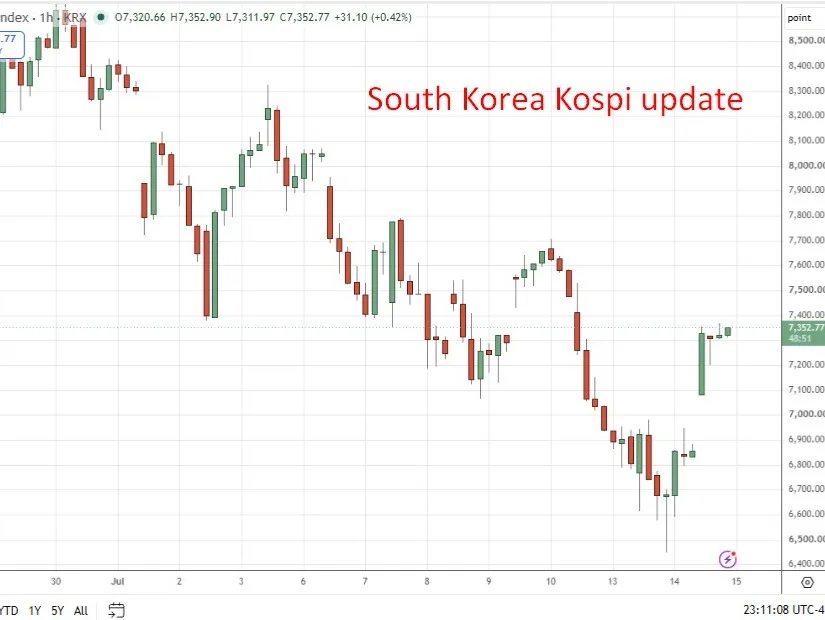
Korea was the standout equity story. The Kospi ripped so hard that the Korea Exchange halted trading twice on circuit breakers. SK Hynix popped 12% — chip demand is back in focus. Japan's Nikkei rose but capped gains ahead of ASML earnings. The Reuters Tankan showed split business confidence in Japan, with Middle East risks keeping sentiment fragile. The BoJ's next rate hike still hinges on whether price increases stick — no clarity there yet.
New Zealand retail sales cooled to +1.3% y/y from a prior +3.3%, a notable deceleration. The PBOC set its USD/CNY midpoint at 6.7910, slightly stronger than the 6.7965 estimate, signaling Beijing wants a stable yuan amid the macro noise. Continue reading at Forexlive.